March 27, 2026
Halifax, Nova Scotia - March 27, 2026 -
Solarenergies.ca has released a new group of city-specific solar offer articles for Halifax, Dartmouth, Bedford, Truro, and Kentville, aiming to give Nova Scotia homeowners a clearer view of what solar looks like in 2026 after the close of several headline federal and provincial programs. The publication said the goal is to replace vague sales talk with local pages that explain what still matters now, including utility rates, local financing structures, battery incentives, and the difference between a low monthly payment and a truly strong deal.
The new articles arrive at a time when many homeowners are still sorting through outdated information and mixed messages. Some pages online still lead with programs that are no longer open, while others focus almost entirely on the monthly payment and skip the financed total. Solarenergies.ca said that the gap has created confusion across the province, especially in markets where city-level financing options can change the real value of a project.
Vitaliy Lano, owner of Solarenergies.ca, stated that the site’s latest city pages were built to answer the questions buyers are actually asking. “A lot of people are still interested in solar, but they are more cautious now,” Lano said. “They want to know if the numbers still make sense in Halifax, Dartmouth, Bedford, Truro, or Kentville. They want to know if 0% financing with zero down is real. They want to know what local options still exist. That is the kind of information these pages are meant to clean up.”
The release highlights a basic reality that now shapes solar decisions across Nova Scotia. Homeowners continue to face Nova Scotia Power’s standard residential rate of 18.187 cents per kilowatt-hour, along with a $19.17 monthly base charge, while the province’s Self-Generating Option remains open for systems up to 27 kilowatts on the same meter. Solarenergies.ca said those two facts still form the backbone of residential solar math in the province, even as the incentive landscape has changed.
What makes the new pages stand out, the publication suggested, is the local detail. In Halifax, Dartmouth, and Bedford, the pages focus on the fact that these communities sit inside Halifax Regional Municipality, where eligible property owners can look at Solar City, a financing structure repaid over 10 years at a fixed 4.75 percent, with early repayment allowed without penalty. In Truro, the page turns to Solar Colchester, which offers property-based financing with terms up to 15 years, a 2.75 percent interest rate, and no fee for paying early. In Kentville, the new page points to the town’s PACE bylaw, which allows solar photovoltaic upgrades to be repaid through a property-based structure over as long as 15 years, subject to eligibility and savings requirements.
Lano commented that local context matters far more than many solar pages admit. “The city name should not just be dropped into the headline and copied into the first sentence,” he said. “There should be a real reason that Halifax reads differently from Truro, and Truro reads differently from Kentville. Homeowners deserve that. It helps them understand what is actually available where they live.”
The publication also puts strong attention on battery storage. Under the current provincial structure, eligible battery systems can still qualify for Efficiency Nova Scotia’s Home Battery Storage Rebate, which can cover up to 40 percent of eligible costs, capped at $300 per kilowatt-hour and $2,500 total, with an added $500 Eco Shift enrollment incentive for eligible participants. Solarenergies.ca expressed that battery conversations have become more relevant as homeowners ask harder questions about backup power, grid interruptions, and how to build a system that feels practical rather than oversized.
Just as important, the release leans into the financing message that has become central to the site’s position in the Nova Scotia market. Solarenergies.ca said qualified homeowners may still be able to explore 0% financing with $0 down, including partner-backed options promoted in the province. Lano added that this message needs to be handled carefully and honestly. “Zero down can be very helpful, and 0% financing can be real,” he said. “But the monthly payment is not the whole story. The financed total matters. The cash price matters. People need to compare both before they decide who is actually giving them value.”
The publication said the new pages are part of a broader effort to make solar easier to understand city by city, while still keeping the message encouraging. Nova Scotia, Lano suggested, is no longer in the stage where solar sells itself on hype alone. Buyers are reading more carefully, asking tougher questions, and looking at financing in a more disciplined way. Solarenergies.ca argues that this is a good shift, not a setback.
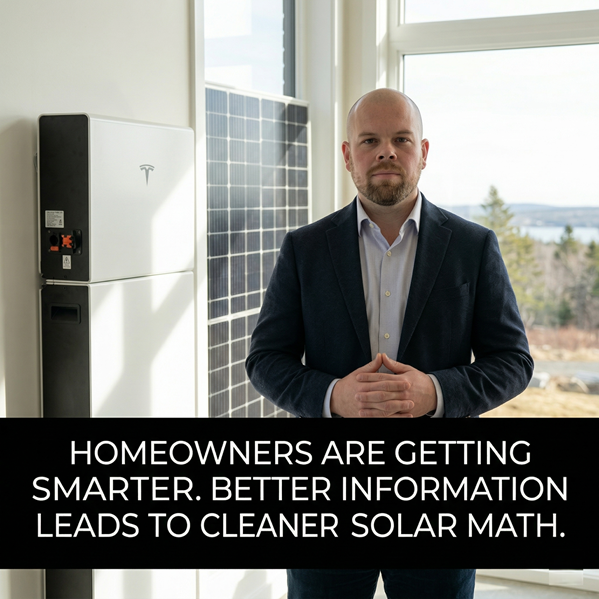
“Homeowners are getting smarter,” Lano said. “That is healthy for the market. Good companies should welcome that. A stronger solar decision usually starts with better local information, cleaner math, and fewer shortcuts.”
The new city pages are now live on Solarenergies.ca as part of the publication’s ongoing effort to connect Nova Scotia homeowners with solar options that fit their roof, location, and budget under current market conditions.
For more information about solar energy in Canada and a free solar calculator, visit the company's website.
###
For more information about Solar Energies In Canada SEIC, contact the company here:
Solar Energies In Canada SEIC
Vitaliy Lano
2368680609
admin@solarenergies.ca

SEIC is Canada’s platform for solar energy insights, dedicated to making green living accessible and practical. From detailed guides to savings calculators, SolarEnergies.ca empowers Canadians to make informed decisions for a sustainable future.